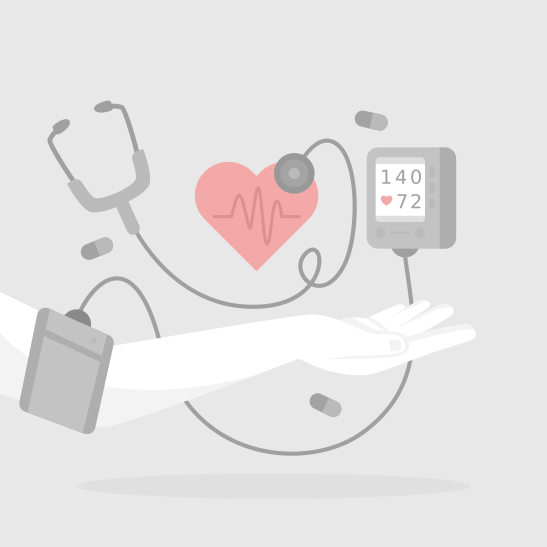
Prehospital Basic Observations
Prehospital basic observations for safe patient assessment
Prehospital basic observations form the foundation of safe and effective patient assessment in the out-of-hospital environment. Early measurement and interpretation of vital signs allow clinicians to identify physiological compromise, monitor trends, and prioritise interventions in time-critical situations.
This resource explores the role of prehospital basic observations, including respiratory rate, oxygen saturation, pulse, blood pressure, temperature, and level of consciousness. Designed for paramedics, EMTs, ECAs, and first responders, it supports structured assessment, early recognition of deterioration, and informed clinical decision-making in frontline care.
Prehospital Basic Observations – Articles

Prehospital Basic Observations – Resources
🔗 NEWS2
National Early Warning Score (NEWS2) guidance outlining the structured assessment of vital signs to identify acute illness and deterioration, widely used across UK emergency and prehospital care.
📥Coming Soon
📖 Coming Soon

Prehospital Basic Observations- Did You Know?
Respiratory rate is often the most sensitive vital sign
Changes in respiratory rate are frequently the earliest indicator of clinical deterioration, often preceding abnormalities in oxygen saturation, heart rate, or blood pressure.
Blood pressure can remain normal in early shock
Compensatory mechanisms may maintain blood pressure despite significant hypovolaemia or sepsis, making other observations such as heart rate, skin signs, and mental status essential.
Level of consciousness is a vital sign
Changes in AVPU or GCS can indicate hypoxia, hypoglycaemia, head injury, or sepsis and should be reassessed regularly alongside physiological observations.
Temperature is often overlooked but clinically significant
Hypothermia or fever can significantly affect patient outcomes and may indicate infection, exposure, or metabolic disturbance, even when other observations appear normal.
Trends matter more than single readings
Repeated observations and trending over time provide greater insight into patient deterioration or response to treatment than isolated measurements.
Prehospital Basic Observations – CPD Reflection Prompts
Reflective practice is a key part of continuing professional development (CPD) and clinical improvement. Use these prompts below to guide your self-reflection on a recent patient assessment involving basic observations.
Reflect on a recent prehospital assessment where basic observations were taken, such as respiratory rate, oxygen saturation, pulse, blood pressure, temperature, or level of consciousness:
- jWhat went well during your initial assessment and recording of vital signs?
- jHow accurate and reliable were the observations you obtained, and were they repeated or trended appropriately?
- jHow did your interpretation of the observations influence your clinical decision-making and priorities of care?
- jWhat challenges did you encounter when obtaining observations (e.g. patient cooperation, environment, equipment, time pressure)?
- jHow did changes in observations over time affect your assessment of patient deterioration or improvement?
- jHow did factors such as age, comorbidities, pain, anxiety, or injury influence the observed values?
asdadasd
Consider writing this reflection in your CPD portfolio or ePortfolio using the Gibbs Reflective Cycle or What? So What? Now What? framework. This reflective exercise not only enhances clinical self-awareness but also provides documented evidence of learning that can count towards your annual HCPC CPD requirements. Keeping detailed, structured reflections like this is essential for maintaining your registration and demonstrating safe, effective, and reflective practice as a healthcare professional. This can count toward your annual HCPC CPD requirements.
Prehospital Basic Observations – FAQs
Frequently Asked Questions about Prehospital Basic Observations in Paramedic Practice
What are prehospital basic observations?
Prehospital basic observations are the core physiological measurements used to assess a patient’s condition before arrival at hospital. These include respiratory rate, oxygen saturation, heart rate, blood pressure, temperature, and level of consciousness (AVPU or GCS), forming the foundation of structured patient assessment.
Why are basic observations important in prehospital care?
Basic observations allow early identification of physiological compromise, guide clinical decision-making, and help prioritise treatment and transport. Changes in vital signs often provide the first indication of deterioration or improvement in a patient’s condition.
Which observation is the most important?
No single observation should be viewed in isolation. However, respiratory rate is often the earliest and most sensitive indicator of deterioration and should be measured accurately and reassessed regularly alongside other vital signs.
How often should observations be repeated?
Observations should be repeated regularly and after any intervention, particularly in unwell or unstable patients. Trending observations over time provides greater clinical insight than a single set of readings.
Can blood pressure be normal in a seriously unwell patient?
Yes. Blood pressure may remain within normal limits in early shock due to compensatory mechanisms. Other observations such as heart rate, respiratory rate, skin signs, and level of consciousness are essential for identifying early deterioration.